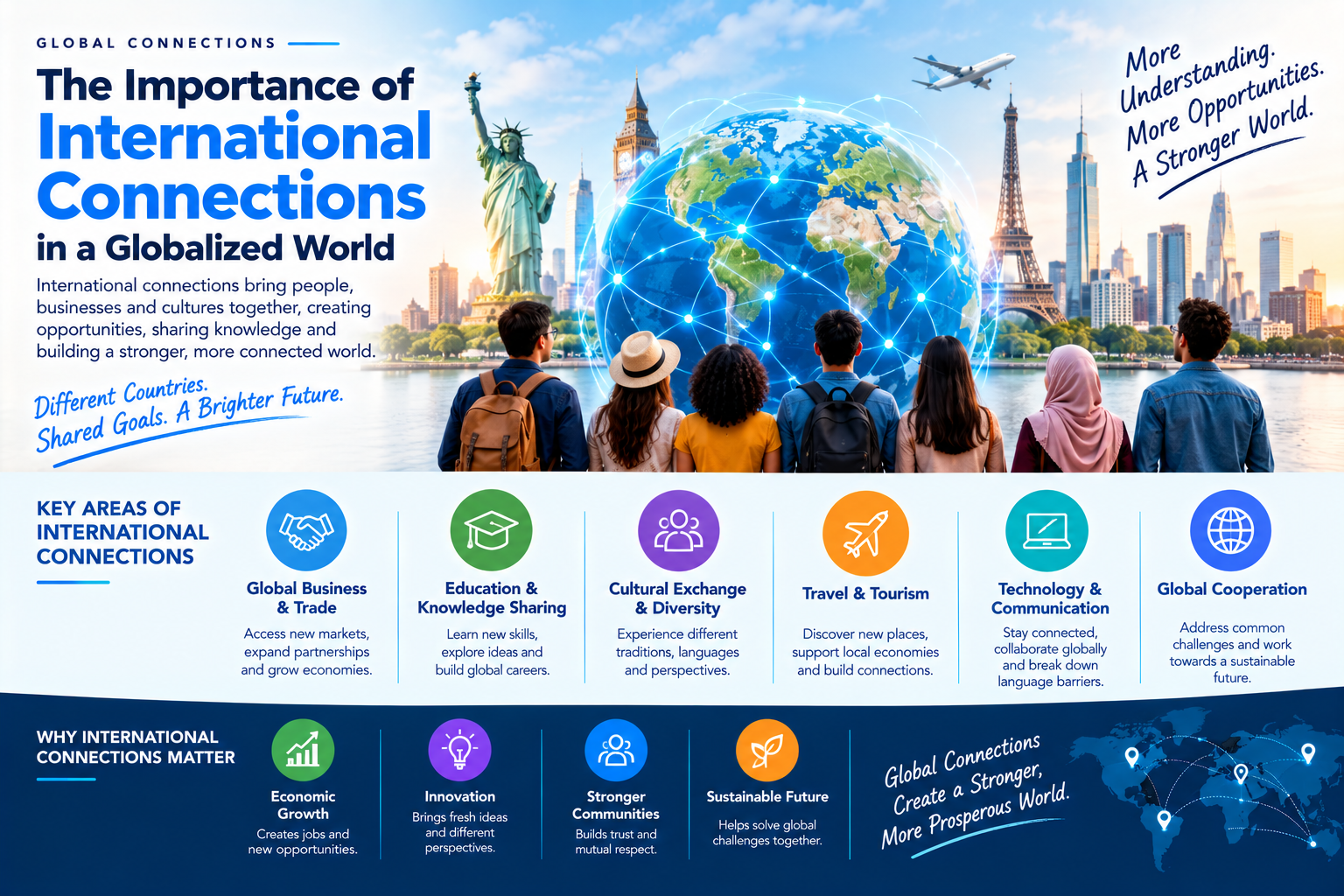
The term international refers to activities, relationships, or cooperation involving two or more countries. It includes business transactions, cultural exchanges, educational programs, tourism, diplomatic relationships, and global partnerships.
International connections help people understand different perspectives, share resources, and work together to address common challenges.
International relationships contribute to economic development, innovation, cultural understanding, and cooperation between countries.
Governments, businesses, educational institutions, and communities can benefit from exchanging ideas and building long-term partnerships. These relationships can also help countries respond to shared challenges such as environmental protection, public health, and economic uncertainty.
Strong international relationships depend on communication, mutual respect, trust, and a willingness to understand different needs and priorities.
International business allows companies to sell products and services in other countries, work with overseas suppliers, and establish partnerships in new markets.
Global trade gives customers access to a wider range of products and helps businesses reach audiences beyond their home countries.
Companies planning international expansion should research local markets, understand customer preferences, evaluate regulations, and consider cultural differences. Careful planning helps reduce risks and improves the chances of building successful international operations.
Technology has made international communication faster and more accessible. Video conferencing, messaging applications, cloud platforms, and collaborative software allow people to work together across different time zones.
Businesses can coordinate international projects, students can attend online courses, and families can stay connected regardless of distance.
Translation tools and digital communication platforms can also help people overcome language barriers, although important conversations may still require professional translation or interpretation.
International education provides opportunities for students and professionals to learn from different academic systems, cultures, and experiences.
Study-abroad programs, student exchanges, international research projects, and online learning platforms help people develop new skills and broaden their perspectives.
Knowledge sharing between countries can support scientific discoveries, professional development, and innovation. These experiences can also help learners build confidence and prepare for careers in global environments.
Every country has its own traditions, languages, food, art, music, and social customs. International cultural exchange helps people explore these differences and appreciate the similarities that connect communities.
Festivals, international exhibitions, travel, films, and cultural programs provide opportunities to learn about other societies.
Respecting cultural differences can reduce misunderstandings, encourage inclusion, and strengthen relationships between people from different backgrounds.
International travel allows people to explore new destinations, experience different cultures, and learn about the history and traditions of other countries.
Tourism also supports local economies by creating demand for accommodation, transportation, restaurants, attractions, and other services.
Responsible international travel involves respecting local customs, following local laws, protecting the environment, and supporting communities in meaningful ways.
Many global challenges cannot be addressed effectively by one country alone. Climate change, infectious diseases, cybersecurity threats, humanitarian emergencies, and economic instability can affect multiple regions.
International cooperation enables governments, researchers, organizations, and communities to share information, coordinate responses, and develop joint solutions.
Successful cooperation requires clear communication, reliable information, shared responsibilities, and a commitment to long-term progress.
Although international connections provide many benefits, they can also create challenges.
Language barriers: Differences in language may lead to misunderstandings.
Cultural differences: Business practices and social expectations can vary between countries.
Time zone differences: Coordinating meetings and projects can be difficult.
Legal and regulatory requirements: Businesses must understand the rules that apply in each market.
Economic uncertainty: Currency changes and global market disruptions can affect international activities.
Digital security risks: Cross-border communication and data sharing require appropriate privacy and security measures.
Understanding these challenges allows individuals and organizations to prepare better and develop more effective international relationships.
Building international relationships takes time, communication, and consistent effort.
Individuals and businesses can strengthen global connections by learning about other cultures, developing language skills, attending international events, participating in professional networks, and using digital communication tools effectively.
Businesses should establish clear agreements, respect local regulations, and maintain transparent communication with international partners.
Trust develops through reliability, mutual respect, and a genuine interest in creating value for everyone involved.
Technology, global education, international trade, and digital communication will continue to influence how countries and communities connect.
Remote collaboration can create opportunities for people to work with international teams without relocating. Digital platforms can also help smaller businesses reach customers in overseas markets.
At the same time, successful international collaboration will require attention to cybersecurity, cultural understanding, fair business practices, and responsible use of technology.
International connections help people and organizations exchange knowledge, build partnerships, explore new opportunities, and understand different cultures. From global business and education to tourism and international cooperation, these relationships contribute to a more connected world.
By communicating effectively, respecting cultural differences, and approaching partnerships with openness and responsibility, individuals and businesses can develop meaningful international relationships and contribute to a more collaborative global community.