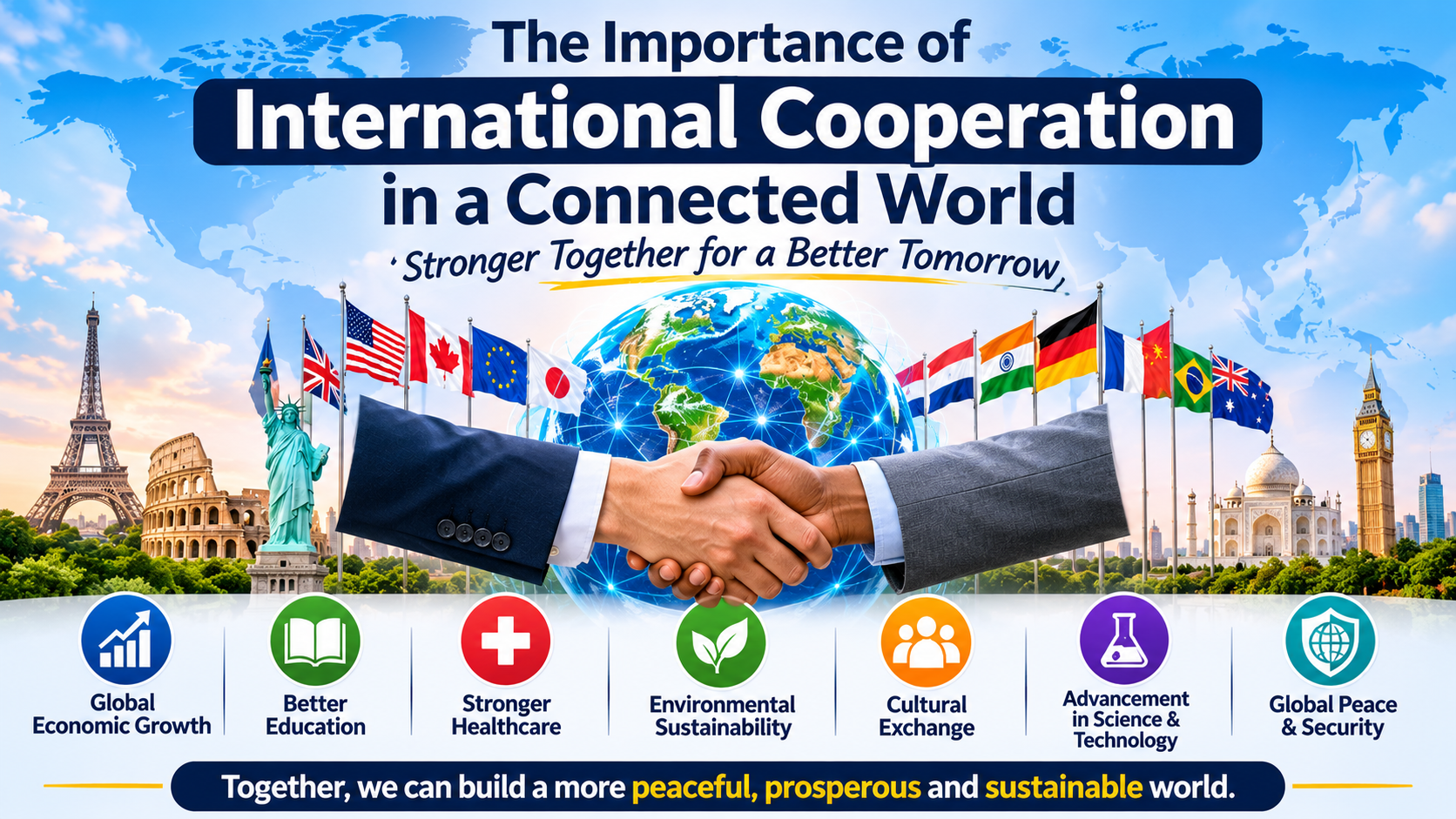
The world is more connected than ever before. Countries depend on one another for trade, technology, education, healthcare, transportation, and economic development. Events in one part of the world can influence businesses, communities, and governments across different continents.
International cooperation helps countries work together to solve common problems, exchange knowledge, and create opportunities for future generations. By building strong partnerships, nations can achieve goals that may be difficult to accomplish independently.
International cooperation refers to the process of countries working together to achieve shared objectives. It involves governments, international organizations, businesses, educational institutions, and communities.
Cooperation can take place through diplomatic discussions, trade agreements, research partnerships, cultural exchanges, environmental programs, and humanitarian support.
The main purpose is to encourage understanding, strengthen relationships, and create solutions that benefit multiple countries.
International trade and investment contribute significantly to economic development. Countries exchange products, services, raw materials, technology, and expertise to support their industries.
Global partnerships allow businesses to reach new markets, create employment opportunities, and improve access to resources.
International trade also encourages innovation because companies can learn from different markets and develop products that meet changing customer needs.
International organizations help countries communicate, establish agreements, and address global challenges.
Some important organizations include:
United Nations (UN): Promotes international peace, security, development, and human rights.
World Health Organization (WHO): Supports global public health and coordinates international health initiatives.
World Trade Organization (WTO): Provides a framework for international trade rules and negotiations.
World Bank: Supports development projects and economic progress in countries around the world.
UNESCO: Promotes education, science, culture, and international cooperation.
These organizations provide platforms for collaboration and help countries work toward common goals.
Education is an important foundation for international understanding and development.
Student exchange programs, international scholarships, research partnerships, and online learning platforms allow people to gain knowledge from different countries.
Students who experience different cultures and educational systems can develop broader perspectives and improve their communication skills.
International academic partnerships also encourage research, innovation, and the sharing of valuable knowledge.
Healthcare challenges often extend beyond national borders. Infectious diseases, medical research, medicine distribution, and public health emergencies require international attention.
Countries can cooperate by sharing scientific information, supporting medical research, improving healthcare infrastructure, and exchanging professional expertise.
International collaboration can also help communities access essential healthcare resources and prepare for future health challenges.
Environmental challenges such as climate change, pollution, deforestation, and biodiversity loss affect countries across the world.
International cooperation is essential because environmental problems cannot always be solved within national boundaries.
Countries can work together to:
Reduce greenhouse gas emissions.
Promote renewable energy.
Protect forests and wildlife.
Improve waste management.
Support sustainable agriculture.
Protect oceans and natural resources.
Working together helps create a healthier environment for future generations.
Every country has unique traditions, languages, food, music, art, and history. Cultural exchange allows people to appreciate these differences and learn from one another.
International festivals, tourism, educational exchanges, sports competitions, and cultural programs help build connections between communities.
Understanding different cultures can reduce misunderstandings, encourage respect, and strengthen relationships between people from different backgrounds.
Technology and scientific research are important drivers of global development. International partnerships allow researchers, engineers, and technology companies to share ideas and work on complex challenges.
Collaborative research can support advancements in renewable energy, artificial intelligence, space exploration, agriculture, medicine, and communication.
Sharing knowledge and expertise helps accelerate innovation and makes scientific progress more accessible across countries.
Although international cooperation offers many benefits, achieving successful partnerships can be difficult.
Some common challenges include:
Differences in political priorities.
Economic inequalities between countries.
Language and cultural barriers.
Trade disagreements.
Conflicts and security concerns.
Different laws and regulations.
Building trust, maintaining open communication, respecting national differences, and creating fair agreements can help overcome these challenges.
The future of the world depends partly on how effectively countries work together. Governments, businesses, educational institutions, and communities all have important roles to play.
Supporting sustainable development, encouraging innovation, improving education, and promoting peaceful relationships can create long-term benefits.
Even small actions, such as learning about other cultures, supporting responsible international businesses, and sharing knowledge, can contribute to a more connected world.
International cooperation is essential for addressing global challenges and creating opportunities for economic, social, scientific, and environmental progress.
By sharing knowledge, respecting cultural differences, and building meaningful partnerships, countries can work toward a more peaceful and sustainable future.
A connected world requires collaboration, understanding, and shared responsibility.